 By CELPIPOnlineTests.com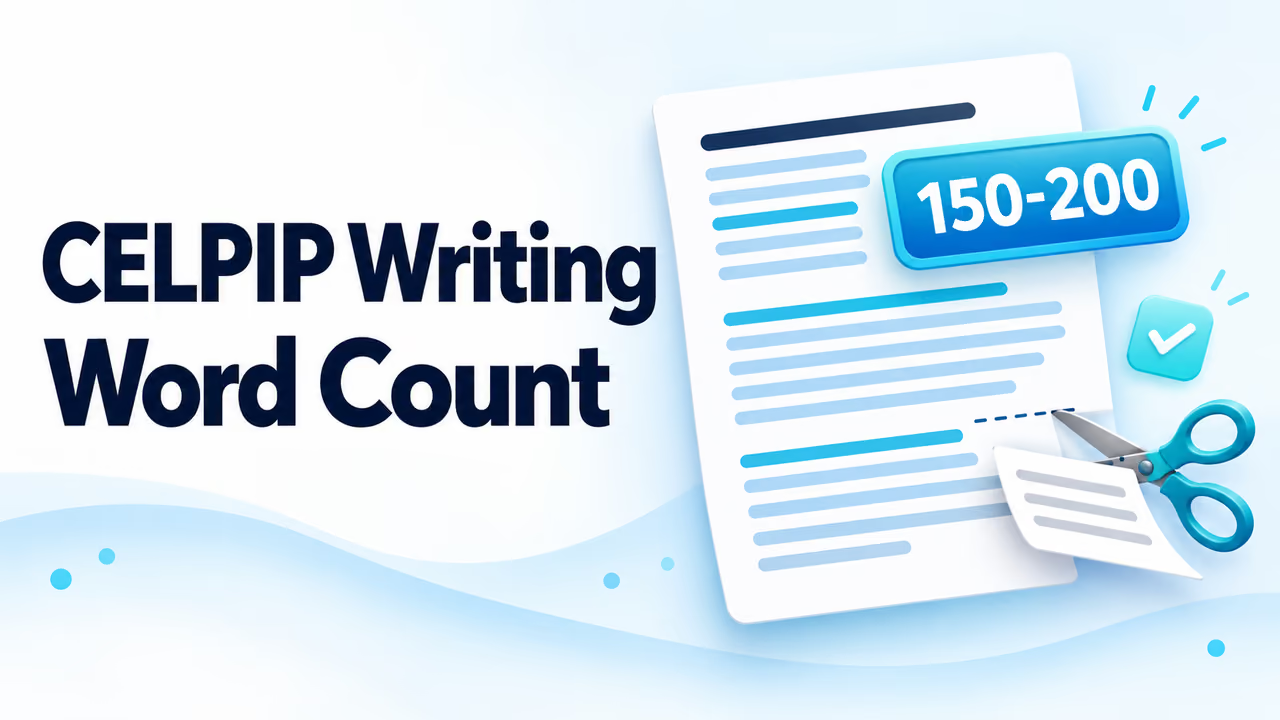
The recommended CELPIP Writing word count is about 150 to 200 words for each response. That means a separate email and survey answer within that range, not 200 words shared between them. If your draft is too long, remove repetition before cutting the details that make your answer complete.
What is the word count for CELPIP Writing Task 1 and Task 2?
| Task | Recommended length | Time |
|---|---|---|
| Task 1: Writing an Email | About 150 to 200 words | 27 minutes |
| Task 2: Responding to Survey Questions | About 150 to 200 words | 26 minutes |
The official 2026 study pack also lists an automatic word counter. Use the displayed count while writing instead of counting words manually. In practice, budget for your entire typed response, including the email greeting and sign-off. Do not remove those useful format cues just to save a few words.
For planning, try drafting toward roughly 180 words. This is a practice target, not an official scoring threshold: it leaves room to add a missing detail or shorten an awkward sentence. If you need the full task instructions and scoring explanation, use the CELPIP Writing test guide.
What happens if you write 210, 220 or 250 words?
You cannot predict a CELPIP level from the word count alone. An online account of someone receiving a high score with 250 words does not establish a safe limit for your response. Equally, the official public tips do not support a claim that word 201 automatically costs one level. If you still have editing time, bring an overlong draft back toward the requested range.
Word count appears under Task Fulfillment in CELPIP's Writing performance standards. The other dimensions assess Content/Coherence, Vocabulary and Readability. A response of exactly 180 words can still be weak if it misses an instruction, repeats unsupported claims or contains confusing sentences.
| What you notice | What to do next |
|---|---|
| The counter is just above 200 | Remove an unnecessary opening phrase or repeated sentence, then reread the join. |
| The draft is around 250 words | Look for an entire repeated idea or irrelevant background detail before trimming individual words. |
| The response is below 150 | Check for a missed instruction, unexplained reason or missing example. |
| The count is in range but a prompt point is missing | Replace weaker material with the missing content. Length alone does not establish completeness. |
How to shorten a CELPIP email without losing meaning
Original practice prompt: The lock on your apartment building's bicycle storage room keeps failing. Write to the property manager. Describe the problem, explain its effect on residents and request a solution. The two responses below are teaching examples, not official test questions or rated answers.
Before: 253 words
Dear Ms. Chen,
I am writing this email to bring to your attention a problem that I have recently experienced with the bicycle storage room in our apartment building. I have been living here for almost two years, and until recently I have generally been very happy with the facilities that are available to residents.
Over the past week, the lock on the bicycle room door has failed on three separate occasions. On Monday morning, I could not get my bicycle out before work, even though I tried my access card several times. I tried it again after waiting for a few minutes, but unfortunately it still did not work at all.
As a result of this situation, I had to take a taxi to the office, which cost me twenty dollars. I also arrived late for an important meeting with my team. Two neighbours told me that they had experienced the same problem with the lock, so it seems that this is not a problem affecting only me.
I would be very grateful if you could arrange for a technician to inspect the lock and repair it as soon as possible. In the meantime, could you please provide residents with a temporary key or another reliable way to enter the room? Please also let us know when the repair is expected to be completed.
Thank you very much for taking the time to read my email and consider my request. I look forward to hearing from you soon.
Kind regards, Alex Patel
Original email, 253 words
All three instructions are addressed, but the first paragraph delays the actual problem. The access-card attempts are described twice, and the closing repeats polite phrases. Those are better places to cut than the taxi cost, the effect on neighbours or the temporary-access request.
After: 167 words, with all three instructions covered
Dear Ms. Chen,
I am writing to report repeated problems with the lock on our building's bicycle storage room. It has failed three times in the past week, preventing residents from accessing their bicycles.
On Monday morning, my access card would not open the door, even after several attempts. I had to take a taxi to work, which cost twenty dollars, and arrived late for a team meeting. Two neighbours have reported similar problems, so the fault appears to affect several residents. Without reliable access, we cannot plan our journeys to work.
Could you please arrange for a technician to inspect and repair the lock this week? Until then, a temporary key available from reception would allow residents to collect their bicycles without waiting for assistance. Please email us the expected repair date and explain how we can obtain the key.
Thank you for looking into this. I can show the technician what happens when I use my card if that would help.
Kind regards, Alex Patel
Original email, 167 words
| Edit | Why it helps |
|---|---|
| State the broken-lock problem in the opening | The manager understands the purpose immediately; the two-year tenancy history is unnecessary. |
| Combine the repeated access-card attempts | The failure stays clear without a second account of trying the same action. |
| Keep the taxi cost, late arrival and neighbours' reports | These details explain the consequences and show that several residents are affected. |
| Keep the repair request and make temporary access concrete | The manager receives a practical action to take while repairs are pending. |
This edit also adds a useful offer to demonstrate the fault. Shortening a draft does not mean deleting every supporting detail. It means choosing which details earn their space. Counts shown here use words separated by spaces and include the greeting and sign-off; on test day, use the on-screen counter.
What should you add if your answer is under 150 words?
Add information that helps the reader understand your answer. For an email, check each requested action: a complaint may explain the fault but omit its impact or a proposed remedy. For a survey, a reason such as 'it is convenient' needs an explanation of who benefits and how.
Original survey situation: Your library can extend weekday evening hours or add more weekend workshops. You prefer longer evening opening. These are paragraph excerpts, not complete Task 2 answers.
Before: a reason that stays general
I prefer extending the library's evening hours because it would be more convenient. Many people are busy during the day, so evening access would help them. This would make the library better for everyone.
Original paragraph excerpt, 34 words
After: a reason with a specific benefit
Extending the library's evening hours would help residents whose work ends after the current closing time. For example, someone finishing at six could collect reserved books or use a computer before going home. Adding more weekend workshops would still leave that weekday access problem unresolved. Later opening therefore meets a practical need that the other option does not address.
Original paragraph excerpt, 59 words
The revision names the affected residents, gives a realistic use of the later hours and explains why the other option would not solve that problem. Build the rest of the response around another distinct reason and a brief conclusion. Do not keep expanding this paragraph until it crowds out the rest of your answer.
- Ask 'Who is affected?' to replace a vague claim about everyone with a relevant group.
- Ask 'What would happen?' to show a consequence of the situation or your proposed choice.
- Ask 'Why does that matter here?' to connect an example to this particular prompt.
- Avoid longer synonyms that add no information, such as changing 'now' to 'at this present moment in time'.
Plan your word count before drafting
For Task 1, assign each instruction a place in your outline before writing the opening. For Task 2, choose your position and two distinct reasons before developing either. The Writing templates guide provides flexible structures if your paragraphs often become unbalanced.
Keep greetings, introductions and closings brief so the body has room for evidence. Check the counter after the first developed paragraph and again after the complete draft. Constantly checking it after every sentence can interrupt your thinking; ignoring it until the final seconds makes substantial editing difficult.
A final editing sequence
- Match the draft to the prompt. Identify where each instruction is answered or where your survey choice is supported.
- Check length. If long, cut repetition and irrelevant background. If short, develop the weakest required point.
- Reread any edited sentences. Deleting a phrase can leave a missing subject, a broken connection or a pronoun without a clear reference.
- Check the ending and count again. Keep the request or conclusion intact and correct errors that affect meaning.
With only seconds remaining, avoid a large rewrite that you cannot reread. Make a small, clear correction or remove one obviously duplicated sentence. During practice, record when you finished drafting so you can adjust your pace next time instead of repeatedly relying on a rushed final cut.
Practise length control on a fresh prompt
Try an unfamiliar email-writing question or survey-response question. Keep the first draft and the revision. Beside each, record its word count, whether every instruction is covered and the most useful edit you made.
On the next prompt, check whether the same problem returns. If your openings are consistently long, practise stating the purpose in one sentence. If your surveys stay short, practise explaining one reason with an example before attempting another timed response. The useful improvement is a complete, clear answer you can produce under the timer.
Prepare with Premium
- All 100 full mock tests (General and LS)
- All 200 Listening, Reading, Writing and Speaking tests
- AI Writing and Speaking evaluation on every test
- Answer explanations for Reading and Listening