 By CELPIPOnlineTests.com
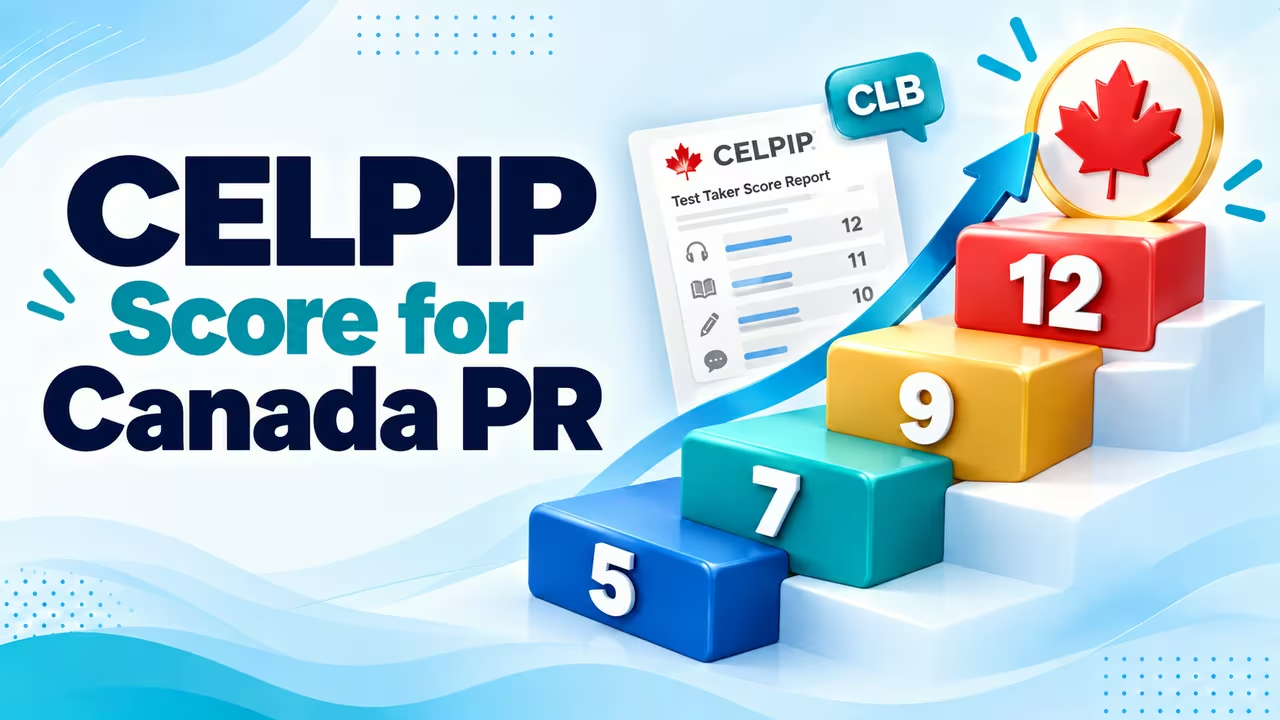
The CELPIP score requirement for Canada PR in 2026 depends on your immigration program. For Express Entry, Federal Skilled Worker candidates need CELPIP 7 in all four skills. Canadian Experience Class candidates need 7 or 5 depending on their occupation's TEER category. Federal Skilled Trades candidates need 5 in Listening and Speaking and 4 in Reading and Writing. CLB 9 can improve your CRS score, but it is not a universal PR minimum.
Your CELPIP result, its CLB equivalent, a program's language minimum and your Comprehensive Ranking System (CRS) points are different things. Meeting the language minimum satisfies one requirement. You must also meet the program's other conditions, and eligibility does not guarantee an invitation.
Minimum CELPIP score for each Express Entry program
These English-language minimums were checked against IRCC's Express Entry requirements on October 11, 2026. CELPIP General scores match the CLB numbers shown below. For the Canadian Experience Class, use the TEER category of the occupation under which you qualify.
| Program | Minimum language level | What that means for CELPIP |
|---|---|---|
| Federal Skilled Worker Program | CLB 7 in all 4 skills | CELPIP 7 in Listening, Reading, Writing and Speaking |
| Canadian Experience Class, TEER 0 or 1 | CLB 7 in all 4 skills | CELPIP 7 in Listening, Reading, Writing and Speaking |
| Canadian Experience Class, TEER 2 or 3 | CLB 5 in all 4 skills | CELPIP 5 in Listening, Reading, Writing and Speaking |
| Federal Skilled Trades Program | CLB 5 in Listening and Speaking, CLB 4 in Reading and Writing | CELPIP 5 in Listening and Speaking, CELPIP 4 in Reading and Writing |
These scores satisfy the language requirement for the listed programs. They do not establish full eligibility or guarantee an invitation. Read the IRCC Express Entry language requirements alongside the other conditions for your program.
For Federal Skilled Worker, meeting CLB 7 is only one step. You also need at least 67 out of 100 on the program's selection-factor grid, as well as its other minimum requirements. That eligibility grid is separate from the CRS score used to rank candidates in the Express Entry pool.
This table covers Express Entry, not every route to permanent residence. Provincial Nominee Program streams have their own requirements. An Express Entry nomination requires you to qualify for both the provincial stream and a federal Express Entry program; check your chosen stream before using this table as your target.
Take CELPIP General, not CELPIP General LS
For Express Entry, IRCC accepts CELPIP General. CELPIP General LS covers only Listening and Speaking, so it cannot support an Express Entry profile. Check CELPIP General vs LS before you book, because the wrong test means paying again.
LS is designed for citizenship, which is a separate application with a lower bar. IRCC asks citizenship applicants aged 18 to 54 for CLB 4 or higher in speaking and listening, and it accepts either CELPIP General or CELPIP General LS for that.
CELPIP General gives you four separate scores: Listening, Reading, Writing and Speaking. IRCC looks at each skill individually, so a strong Listening score does not make up for a lower Writing score. If you have not chosen a test yet, the best English test for Canada PR compares CELPIP, IELTS General Training and PTE Core, and our guide to the CELPIP test explains how CELPIP itself works.
Is CELPIP 9 the same as CLB 9?
| CELPIP level | CLB level | Where it matters |
|---|---|---|
| 4 | CLB 4 | Federal Skilled Trades minimum for Reading and Writing |
| 5 | CLB 5 | CEC minimum for TEER 2 or 3; FST minimum for Listening and Speaking |
| 7 | CLB 7 | Federal Skilled Worker minimum and CEC minimum for TEER 0 or 1 |
| 8 | CLB 8 | Above the CLB 7 minimum, but earns fewer CRS points than CLB 9 |
| 9 | CLB 9 | The level many candidates target for extra CRS points |
| 10, 11 or 12 | CLB 10, 11 or 12 respectively | CRS first-language points reach their maximum at CLB 10 or above |
Ignore the Average Score on your CELPIP report for immigration. The CELPIP score FAQs explain that IRCC does not use it and that it does not equal a CLB level. Only the four component scores count.
If you already have an IELTS General Training result, IRCC converts it to CLB with a separate table. The IELTS to CELPIP score converter shows the CELPIP level that matches each band, and CELPIP vs IELTS covers the practical differences if you are deciding whether to switch.
Why CLB 9 matters for CRS points
The CRS awards points for each language ability separately, and the step from CLB 8 to CLB 9 is one of the larger jumps in the table. The figures below come from IRCC's CRS criteria for your first official language, checked on October 11, 2026.
| CLB level per ability | Without spouse or partner | With spouse or partner |
|---|---|---|
| CLB 7 | 17 | 16 |
| CLB 8 | 23 | 22 |
| CLB 9 | 31 | 29 |
| CLB 10 or more | 34 | 32 |
For a single applicant, moving from CLB 8 to CLB 9 in all four abilities adds 32 points (8 per ability) before anything else changes.
Use the without-spouse column if your spouse or common-law partner is not accompanying you to Canada, or is already a Canadian citizen or permanent resident. With an accompanying spouse or partner, moving all four abilities from CLB 8 to CLB 9 adds 28 first-language points (7 per ability).
Reaching CLB 9 in all four abilities can also increase points for education or foreign work experience combined with language. In the foreign-work-and-language table, three or more years of foreign work receives 25 points when every ability is at least CLB 7 but one or more is below CLB 9, compared with 50 when all four reach CLB 9. Category caps can limit the increase in your total.
How much this changes your total depends on your age, education, work history and partner's details. Enter your own figures in IRCC's CRS tool, or ask a licensed immigration professional, before you decide a higher score is worth another test.
What if one CELPIP skill is lower?
Check every skill against its own program minimum. Federal Skilled Trades has different minimums for Listening and Speaking than for Reading and Writing. For the all-four CLB 9 tier, every ability must reach 9: with Listening 9, Reading 9, Speaking 9 and Writing 7, you meet a CLB 7 language minimum but earn CLB 7 points for Writing and stay in the lower language band for skill transferability.
If Writing is 6 instead, those same three 9s cannot make up the shortfall for Federal Skilled Worker or CEC TEER 0 or 1. That combination does meet the CEC TEER 2 or 3 language minimum, but only candidates who also satisfy that program's work-experience and other requirements can use it.
Diagnose the weaker skill before booking another test. In Writing, check whether you miss prompt points, run out of time or repeat the same grammar errors. In Speaking, check whether your answers are too short or hard to follow. In Reading or Listening, find the part where you lose the most marks.
Then pick one focused guide: the Writing task and review guide, the Speaking response guide, the Reading score diagnosis or the Listening note-taking tips.
- Write down your four component scores, not the average.
- Check the level your program requires, and whether you want CLB 9 in all four.
- Choose the one skill furthest below your target.
- Practise that skill in short timed sessions, such as one Writing task or one Listening part a day, and log each mistake.
- Take another timed mock test to check whether the change holds on new material.
How CELPIP scores each skill
Listening and Reading are scored by computer from your answers. Writing and Speaking are rated against published performance criteria, so a count of correct answers cannot predict those two skills. CELPIP explains the criteria on its test results page and confirms its Writing AI-human hybrid system in the official scoring FAQs.
| Skill | How it is assessed | What to practise |
|---|---|---|
| Listening | Computer scored; raw scores are adjusted for small differences between test forms | Catching main ideas, details and speaker purpose under time pressure |
| Reading | Computer scored; raw scores are adjusted for small differences between test forms | Pace, recognising paraphrases and reading each question carefully |
| Writing | AI-human hybrid scoring verified by human raters, for content/coherence, vocabulary, readability and task fulfillment | Planning, covering every point and leaving time to check your work |
| Speaking | Rated by three to five trained raters for content/coherence, vocabulary, listenability and task fulfillment | Clear, organised answers with enough detail in the time allowed |
CELPIP publishes approximate raw score ranges for Listening and Reading, but the number needed for a level can vary slightly between test forms. Treat any practice result as a signal, not a prediction. A free CELPIP General mock test gives you a four-skill baseline to compare with your target.
How to choose your own target score
Start with the minimum you need, then decide whether a higher target is realistic and useful. Someone who needs only the CEC minimum for a TEER 2 job has a different plan from someone trying to raise a CRS score with CLB 9.
- If you are below your program minimum, aim first to meet it in every skill.
- If you already meet the minimum, estimate your CRS score at CLB 9 before deciding to chase a higher result.
- If one skill is holding you back, spend most of your time on that skill instead of repeating your strongest one.
- If your result will be two years old before you expect to submit your PR application, retest early enough to allow for results and a possible second attempt.
Our CELPIP score calculator turns four CELPIP scores into CLB levels and shows which skill is holding you back. It is a planning tool, not an official immigration decision.
How long CELPIP results stay valid
If your result is approaching its second anniversary, use our CELPIP validity and PR retest planning guide to compare your test date with your submission timeline, including expiry after an invitation.
For Express Entry, your language test results must be less than two years old on the day you complete your profile and again on the day you submit your permanent residence application. IRCC says it will refuse a PR application that relies on expired results. CELPIP's results page describes scores as valid for five years, but for Express Entry the IRCC two-year rule is the one that counts.
Scores usually appear in your CELPIP account 2 to 4 business days after the test. If you are considering a re-evaluation, CELPIP allows requests within six months of the test date and estimates about one to two weeks for a decision. Check the official results and re-evaluation guidance before paying, and allow enough time to retest if your result stays below your program minimum.
Your next step: measure all four skills
Take one timed mock test, write down your four results and compare them with your program minimum and your CLB 9 goal. If one skill is lower, that is where your study time goes. If two or more skills need work, the 30-day CELPIP study plan spreads practice across all four with regular checkpoints.
Prepare with Premium
- All 100 full mock tests (General and LS)
- All 200 Listening, Reading, Writing and Speaking tests
- AI Writing and Speaking evaluation on every test
- Answer explanations for Reading and Listening