
 By CELPIPOnlineTests.com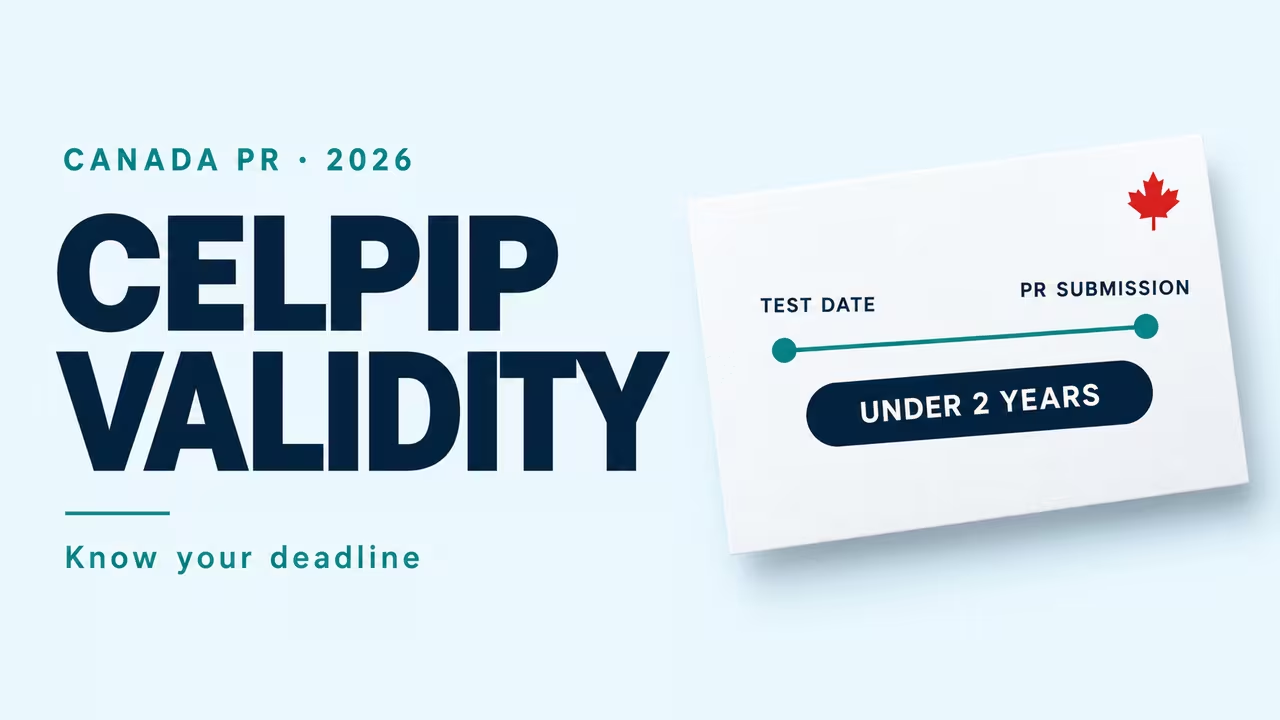
For Canada PR through Express Entry, your CELPIP results must be less than two years old when you complete your profile and when you submit your permanent residence application. An invitation to apply does not extend that window. These are the current IRCC language-test rules, checked on 10 October 2026.
Start with your test date, your planned PR submission date and your four component scores. If you need to choose a score target, use our CELPIP score requirements for Canada PR. Here, the question is whether those results will still be usable when you need them.
Is CELPIP valid for two years or five years?
The official CELPIP results page currently describes scores as valid for five years from the date the report is issued. It separately says results can be viewed in your account for five years from the test date. Neither statement overrides IRCC's acceptance requirements for Express Entry.
This article focuses on Express Entry. Other PR pathways can have additional requirements, including provincial-stage checks. IRCC's language requirements for immigration programs direct applicants to the relevant program instructions. Citizenship is a separate process; do not use this PR timeline as a citizenship checklist.
Calculate your expiry boundary from the test date
Mark the second anniversary of the day you took CELPIP. On that anniversary, the result is already two years old. Downloading a fresh PDF does not restart the clock. For planning, set an earlier personal submission target so a missing document or technical problem does not push you onto the boundary.
| Date | What it means |
|---|---|
| 20 November 2024 | Original test date; start the age calculation here. |
| 10 October 2026 | The result is still under two years old, but there is limited time left. |
| 19 November 2026 | Still before the second anniversary. Avoid relying on the final day to submit. |
| 20 November 2026 | Exactly two years old; outside Express Entry's less-than-two-years requirement. |
Write both deadlines on your calendar: the language-result boundary and the submission deadline displayed in your IRCC account. Treat them as separate constraints. A longer invitation window does not make an older test usable.
Expiry at each stage of Express Entry
While you are waiting in the Express Entry pool
The current Express Entry Ministerial Instructions explain that results reaching two years of age affect whether you meet the requirements while in the pool. A result that was valid when you created the profile cannot simply be left there indefinitely. Keep your information current and check the status shown in your account.
After an invitation to apply, before you submit
IRCC gives you 60 days to respond to an invitation. If your test will expire sooner, assess whether you can submit a complete application before expiry or obtain a new eligible result in time. If neither works, IRCC lists declining the invitation among the options. A later invitation is not guaranteed.
After a complete PR application has been submitted
IRCC's published language guidance checks result age at application receipt. Our reading of that guidance is that later expiry during processing does not, by itself, mean you must automatically retest. This is different from submitting with an already-expired result. Follow any individual request from IRCC for updated documents; the general timing rule cannot settle every case.
Plan a retest without gambling on the last available date
Work backwards from when you need usable results, rather than booking the final sitting before a deadline. Check available appointments, leave time to study, and allow space to deal with a result that is lower than expected.
CELPIP's results page currently gives a usual turnaround of 2 to 4 business days and notes that results can be delayed. Weekends and holidays do not count as business days. That is a planning estimate, not a promise that a late test will rescue an application deadline.
- Save your existing report and record the test date, each skill score and the expiry boundary in one place.
- Check your application stage and the deadline displayed in your account. Identify any other documents that could delay submission.
- Check official test appointments early. Choose a sitting that leaves room for preparation and results, rather than relying on the fastest advertised turnaround.
- Take a diagnostic mock before allocating your study hours. Compare all four skills with your target, including skills that were strong two years ago.
- When the new result arrives, review the actual scores and the application information together. Do not assume a new report automatically preserves your previous points.
What if the new CELPIP score is lower?
A retest renews the evidence of your language ability; it does not guarantee the same score. IRCC tells applicants to recalculate CRS when circumstances change and to decline an invitation if the recalculated total falls below the lowest score for that round. You also need to remain eligible for the program and invitation category that applies to you.
For example, someone whose preparation target is 9 in every skill should track Reading 9, Listening 9, Writing 9 and Speaking 9 separately. If a practice result suggests Writing has slipped, repair that weakness while keeping the other skills active. The CELPIP score calculator helps compare component levels; use IRCC's scoring tools for your full immigration profile.
A focused practice cycle before your retest
If you have two weeks available, use the sequence below as a review cycle. It is a study suggestion, not a claim that two weeks is enough to reach a particular score. If your baseline is far below your target, use a longer preparation period.
| Stage | Practice action |
|---|---|
| Days 1 and 2: diagnose | Complete an unseen mock, then review unfinished tasks, guesses and recurring errors. Save your first Writing drafts and Speaking recordings. |
| Days 3 to 8: repair | Work on the weakest task type each day. Explain missed Listening and Reading answers using evidence. Revise one Writing paragraph or re-record one Speaking response after reviewing feedback. |
| Days 9 to 11: transfer | Attempt fresh prompts under timers. Check whether the improvement holds without replaying, reading a model answer or restarting. |
| Days 12 to 14: rehearse and review | Use a different full mock in Exam Mode. Review all four skills and adjust the remaining study time around the largest unresolved problem. |
Use Listening practice or Reading practice when timing or answer evidence is the problem. For productive skills, Writing practice with AI evaluation and Speaking practice with AI feedback can help you identify issues to review. AI feedback is practice guidance and does not certify an immigration score.
In our CELPIP General full mocks, Practice Mode supports learning tools such as audio replay and Speaking re-recording. CELPIP Exam Mode applies stricter playback, navigation, timers and Speaking attempts. Use Practice Mode to understand mistakes, then use an unseen mock in Exam Mode to check performance under pressure. Select the mode on the mock entry page.
Full Mock 1 is free. Pro unlocks more tests; see current practice access and pricing before choosing a plan. If you need a longer routine, follow the 30-day CELPIP study plan. Keep your immigration calendar alongside your study calendar so preparation decisions reflect both.
Final checks before you rely on a CELPIP result
- Confirm that you have CELPIP General and are checking the requirements for your specific pathway.
- Use the original test date, not the email notification date or the day you downloaded the PDF.
- Recheck the result's age against your actual submission plan, not just the date of your invitation.
- Compare every component score with your target and review any change in your immigration points.
- Keep preparation estimates separate from official test results. Submit the official information requested by IRCC.
Prepare with Premium
- All 100 full mock tests (General and LS)
- All 200 Listening, Reading, Writing and Speaking tests
- AI Writing and Speaking evaluation on every test
- Answer explanations for Reading and Listening