Prepare with Premium
Unlimited access to CELPIP practice, AI evaluation and detailed explanations.
- 100 CELPIP General mock tests
- 100 CELPIP General LS mock tests
- 100 tests for each skill (L/R/W/S)
- Unlimited AI Writing evaluation
- Unlimited AI Speaking evaluation
- Detailed answer explanations
Knowing the CELPIP test format makes preparation much easier. You know what comes first, how long each section lasts and what you need to do on screen. That means less stress on test day and better use of your study time. This guide covers the CELPIP General test, the version used for permanent residence and many professional purposes. If you are preparing for citizenship, read the section on CELPIP General LS as well.
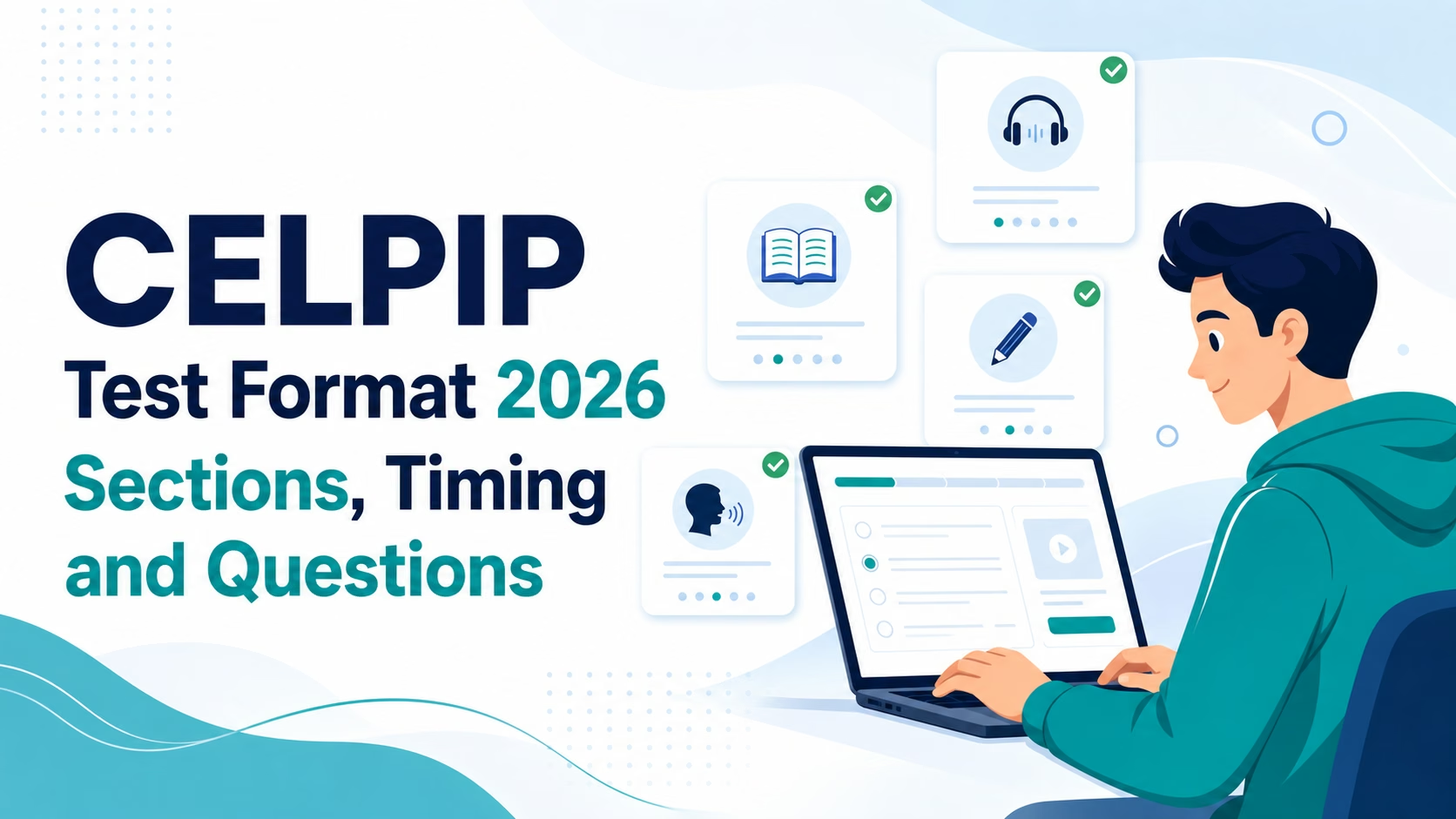
CELPIP General has four sections in a fixed order: Listening, Reading, Writing and Speaking. You complete the test on a computer in one sitting. The official format can change, so use this guide to understand the experience and check the official CELPIP test format page before you book.
CELPIP test format at a glance
Plan for about three hours at the test centre, plus check in time. The test itself is divided into four skill sections. Listening and Reading use selected response questions. Writing and Speaking ask you to create your own response under a timer.
| Section | What you do | Published time | Main format |
|---|---|---|---|
| Listening | Listen to six everyday recordings and answer questions | About 46 to 55 minutes | 38 questions across 6 parts |
| Reading | Read messages, a diagram, an information text and viewpoints | About 43 to 56 minutes | 38 questions across 4 parts |
| Writing | Write an email and respond to a survey question | About 53 minutes | 2 writing tasks |
| Speaking | Record answers to on screen prompts using a headset | About 15 minutes | 8 speaking tasks |
CELPIP General and CELPIP General LS
Choose the test that matches your application. CELPIP General tests all four skills and is the test required for most permanent residence applications. CELPIP General LS tests only Listening and Speaking and is commonly used for Canadian citizenship. The right choice depends on the program, so check its official requirements before paying for a test.
| Test version | Skills | Typical use |
|---|---|---|
| CELPIP General | Listening, Reading, Writing, Speaking | Permanent residence and many professional requirements |
| CELPIP General LS | Listening and Speaking | Canadian citizenship and selected requirements |
For Express Entry, IRCC says you must take CELPIP General, not General LS. You can confirm the accepted tests and language rules on the IRCC Express Entry language test page.
What happens on CELPIP test day
Arrive early with the identification you used to register. At the test centre, staff check your ID and take you to a computer station with a headset. Once the test begins, the four sections run in order. You do not choose the order and you cannot return to a section after it ends.
- Check in and show your original identification.
- Settle at your computer station and follow the instructions on screen.
- Complete Listening, then Reading, then Writing, then Speaking.
- Watch the timer in every section and submit before time ends.
- Finish the test and wait for your results in your CELPIP account.
The format rewards calm pacing. You do not need to rush every question, but you do need to notice the timer and move on when a question is taking too long. A full CELPIP General mock test is the best way to practise the rhythm of a long computer based exam.
What to bring and what the test centre provides
Bring the original, valid photo identification that you used when registering and your test confirmation email. The name and document details must match your registration. Do not rely on a photocopy, an expired document or a different form of ID. Check the accepted identification for your country on the official CELPIP test day page before you travel.
The test centre provides the computer, a standard QWERTY keyboard, headset, microphone, pen and notepaper. You return the pen and paper when the test ends. Keep your phone, watch, notes and other personal items outside the test room. You do not need to buy a special keyboard or bring your own headset.
Breaks, noise and other test day questions
CELPIP is a timed test. If you need the washroom or more notepaper, raise your hand and follow the test centre staff instructions. The timer does not stop for a washroom break, so use the washroom before check in and manage your time carefully. You may also hear other candidates typing or speaking. This is normal in a test room.
If you need an accessibility adjustment, food, drink or medical equipment during the test, ask about special accommodations before test day. These arrangements need approval in advance. If a technical or test day issue happens, tell staff straight away and report it through your CELPIP account within the stated reporting window.
CELPIP Listening format
Listening comes first. You hear recordings about everyday situations, such as solving a problem, a daily life conversation, information, a news item, a discussion and different viewpoints. The audio plays once, so listen for the main point, the speaker's purpose and the details that answer each question.
- Part 1: Listening to Problem Solving.
- Part 2: Listening to a Daily Life Conversation.
- Part 3: Listening for Information.
- Part 4: Listening to a News Item.
- Part 5: Listening to a Discussion.
- Part 6: Listening to Viewpoints.
The most common mistake is trying to write down every word. Instead, make short notes about names, choices, reasons, numbers and changes of opinion. Then read each answer option carefully. CELPIP often tests whether you understood the meaning, not whether you remember the exact words. Build this habit with timed CELPIP Listening practice.
How to manage time in Listening
Read the question and answer choices when the screen gives you time. During the recording, listen for the answer instead of trying to translate every sentence in your head. If you are unsure, choose the best answer and keep moving. You cannot replay the audio, so protecting your focus is more useful than worrying about one difficult question.
CELPIP Reading format
Reading has four parts. You read a message, use information from a diagram, read an information text and compare viewpoints in an article and comment. The questions ask you to find details, understand the main idea, make an inference and match paraphrased meaning.
- Part 1: Reading Correspondence.
- Part 2: Reading to Apply a Diagram.
- Part 3: Reading for Information.
- Part 4: Reading for Viewpoints.
Do not read every passage at the same speed. First understand the question, then scan for the part of the text that answers it. In the longer sections, mark the writer's main view and the reason behind it. This saves time and helps when two answers use similar words. Try a CELPIP Reading practice test to practise this under realistic time pressure.
How to manage time in Reading
Start with a quick look at the question. This tells you what to find in the text. Scan for names, dates, key nouns and similar ideas, then read the small section around the answer carefully. Do not spend too long on one question. Mark your best answer, move on and use any remaining time to review only the questions you found difficult.
CELPIP Writing format
Writing has two timed tasks. Task 1 is an email and Task 2 is a survey response. Official study materials give 27 minutes for Task 1 and 26 minutes for Task 2. Both tasks usually ask for 150 to 200 words. The prompt gives you points to cover, so read it closely before you start writing.
| Task | Your goal | Useful planning step |
|---|---|---|
| Task 1: Writing an Email | Write a clear email that covers every requested point and uses the right tone | List the three prompt points, then give each one its own short paragraph |
| Task 2: Responding to Survey Questions | Choose one option and give clear reasons with supporting detail | Choose quickly, then plan two or three specific reasons |
A strong answer is clear, complete and easy to follow. Fancy words do not help if you miss a prompt point or run out of time. Leave a few minutes to check that your tone, grammar and word count fit the task. You can practise both tasks with CELPIP Writing practice tests.
A simple Writing time plan
Spend the first few minutes planning. For the email, decide the purpose, tone and one clear detail for each point in the prompt. For the survey, choose an option quickly and list your reasons. Spend most of the time writing. Save the final minutes for a short check: did you answer every part, use paragraphs and correct obvious errors? The on screen word counter helps you stay near the suggested length.
CELPIP Speaking format
Speaking is completed with a headset, not with a live examiner in the room. You see a prompt, get a short time to prepare and record your answer. The eight tasks are short, but they test how clearly you can organize ideas and speak about common situations.
- Giving Advice and Talking about a Personal Experience.
- Describing a Scene and Making Predictions.
- Comparing and Persuading and Dealing with a Difficult Situation.
- Expressing Opinions and Describing an Unusual Situation.
| Task | What you need to do | Easy answer plan |
|---|---|---|
| 1. Giving Advice | Help someone solve a problem | Give your main advice, then two reasons |
| 2. Personal Experience | Tell a short true or believable story | Set the scene, explain what happened, share the result |
| 3. Describing a Scene | Describe people, places and actions in a picture | Start with the big picture, then move through key details |
| 4. Making Predictions | Say what may happen next | Make a prediction, then explain the clues |
| 5. Comparing and Persuading | Choose between options and convince someone | Choose one option, compare it with the other, give reasons |
| 6. Difficult Situation | Respond politely to a problem | State the issue, explain the effect, ask for a solution |
| 7. Expressing Opinions | Give and support your view | State your opinion, give two reasons, finish clearly |
| 8. Unusual Situation | Describe a surprising picture or event | Name the main event, add details, explain why it is unusual |
Use the preparation time to make a simple plan. Start with your main answer, add two details or examples, then finish cleanly. Do not try to memorize a long script. It can make you sound less natural and it is hard to adapt when the prompt changes. Review the complete CELPIP Speaking test guide, then record yourself with CELPIP Speaking practice tests and listen for pauses, missing detail and repeated words.
Do I need a perfect accent for CELPIP Speaking
No. Focus on being easy to understand. Speak at a steady speed, use simple linking words and give enough detail to answer the task. A clear, organized answer is stronger than a rushed answer with difficult words. Practise speaking at a normal volume because other candidates may be speaking in the room at the same time.
Do all CELPIP questions count toward your score
CELPIP may include unscored Listening or Reading items for test development. They look like regular questions and can appear anywhere in those two sections. You are not told which items are unscored, so give every question your best effort. Do not change your strategy because you think a question might not count.
This is another reason to keep a steady pace. Your goal is to answer every item carefully, not to guess which questions matter. The official CELPIP FAQ confirms that unscored items use the same format as the scored items.
How CELPIP scoring fits the format
You receive a separate CELPIP level for each skill. Listening and Reading use your answers to the questions. Writing and Speaking are assessed using scoring criteria. Your result report shows the four skill scores instead of one combined total score.
For immigration, the score you need depends on your program and your profile. Do not guess from a practice score alone. Use the CELPIP score calculator for an estimate, then confirm the official language requirement for your application.
How to prepare for the CELPIP format
- Take one timed mock test to see your starting point.
- Learn the task type and timer for each section before you focus on speed.
- Practise your weakest skill in short, regular sessions.
- Review every wrong answer and name the reason you chose it.
- Take another full mock test after a few weeks to check your pacing and progress.
If the whole test feels overwhelming, prepare one section at a time. Start with Listening or Reading for accuracy, then add Writing and Speaking practice where timing and response structure matter most. Finish your preparation with a full run so the order of the sections feels familiar.
Results and what to do after the test
CELPIP says results are available through your online account in two to four business days after the test date. When results are ready, you can view each skill score and download your official score report. Check the official CELPIP results page for the current timeline and re evaluation rules.
If there was a serious problem during the test, do not wait until results arrive. Tell the test centre staff immediately and follow the official process for reporting a test day issue. Keep your confirmation email and note the time and details of what happened.
Ready to experience the CELPIP format?
Take a free timed mock test and see how the four sections feel together. Your results will show where to focus your next practice session.